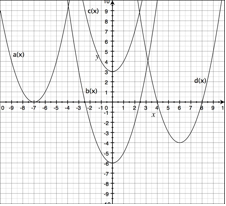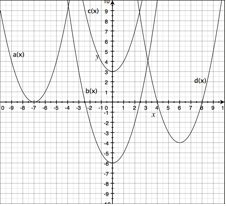
We ended the functions unit before Thanksgiving. I'm not giving a comprehensive test until just before winter break, and I think that is good, so they can have more time for it to sink in. The new unit is on systems of equations and inequalities, but I'll post about that later on, when I have more time. Here are the last files of the unit.
Lesson 15 (Practice and Skills Test)
Lesson 16 (Translating Parent Functions)
Lesson 16 Keynote
Keynote Quicktime
Tuesday, December 02, 2008
Algebra 2: Parent Functions
Posted by
Dan Wekselgreene
0
comments
Labels: algebra 2, lesson, translating
Thursday, November 20, 2008
Algebra 2: Horizontal Shift and Review/STAR Problems

Translation and transformation have continued to prove extremely difficult for my classes. Even my strongest students have been struggling. I'm still trying to work out what is making it so hard to understand (if anyone has insight on this, I'd really love to hear it). I think they are starting to get the hand of it, but for mastery, we'd need at least another full week, and that is time we just don't have - especially for something that is only tangentially in the standards.
I did incorporate the idea of texting in lesson 14, to introduce what I'm calling "translation notation". We're not talking about vectors or anything like that, but I wanted to give them an efficient way to describe the translations and calculate with them. The kids thought it was really funny; I did play it up, calling it "math chisme" (gossip) and pretending I was texting it under my sweatshirt to my friend. You wouldn't want to type out that whole sentence, right?
Anyway, here are the files from this week.
Lesson 12 (Horizontal Shift) Keynote Quicktime
Lesson 13 (Translation and Transformation Practice) No Keynote for this one
Lesson 14 (More Translation and Transformation) Keynote Quicktime
Posted by
Dan Wekselgreene
1 comments
Labels: algebra 2, lesson, translating
Saturday, November 15, 2008
Algebra 2: Vertical Translation and Transformation

I've been really good about my timing all year, until this lesson... I wasn't able to finish it in any of my classes. We almost got to the end of the Keynote, and didn't have any time for independent practice. But that's why I don't really create more than one lesson at a time - so I can adapt as needed. Well, that and it takes a huge amount of time, and keeping afloat is what it's all about. I'm still not sure why this lesson took so long; some students were tearing through the class notes, figuring it out on their own and finishing before we even go there. And some students were struggling to keep up. I know it's always kind of like that, but we are working with a very visual representation right now, and it has shifted some of the dynamics of the classes.
Coming soon will be horizontal shift, but not horizontal stretch. I don't want to overload them, and the standards in Algebra 2 really only require that students be able to graph things like f(x) = a(x - h)^2 + k, or to say how one vertex form parabola got shifted to another one. They can learn horizontal stretch in pre-calculus with the trig functions. At least this will give them a good foundation for the tedious work of grinding through f(x) = -2sin(3x-pi/2)+5.
Lesson 11 (Vertical Shift / Stretch)
Lesson 11 Keynote
Keynote Quicktime
Posted by
Dan Wekselgreene
2
comments
Labels: algebra 2, graphical analysis, lesson, translating
Wednesday, October 18, 2006
Next Lesson: Translating Functions

Tomorrow, we will be leaving piecewise functions behind for a while. The students this year are doing better overall than last year, but some students still are having significant struggles with understanding piecewise functions. When asked to graph a single line in a restricted domain, that seems to be fine. But as soon as the pieces are put together, students get very confused between the f(x) value from the equation, and the x-values from the domain condition (I haven't graded the quiz yet, so I'll have some better information about this soon).
We'll come back to it when we review for the unit test and the final exam, but for now, we need to move on. The goal for the next lesson is for students to understand vertical and horizontal shifts - why they happen, how to determine the shift, and how to generate translated graphs.
For the Do Now, students will be asked to plot out y = x^2 and y = x^2 + 3, and compare the graphs. They will do the same for y = x^2 and y = (x - 2)^2. At this point, they are working by hand so that they can, point by point, see what is happening. We will discuss their results and get some initial conjectures out. Then, they will do a graphing calculator exploration of the same ideas, which will allow them to graph more functions more quickly.
After this, we'll put the ideas together as I do some direct instruction, and define the concepts of vertical and horizontal shift. We will use what they've learned to understand why the vertex of y = a(x - h)^2 + k is (h, k) - which is, after all, a state standard! Yes! I hope that providing more scaffolding on translations will help them understand the vertex form better. I also think it will help them be more prepared for all those crazy phase-shifting, period changing trig functions they will encounter in pre-calc (along with the upcoming lesson, which will look at stretching transformations, in general and with specific attention to absolute value functions).
Update:
I graded quiz 2 and the scores were lower than I'd hoped:
10| 0
9| 0 3 3
8| 0 3 3 3 5 8 8
7| 1 3 3 6 6 8
6| 3 6 8
5| 1 4 6
4| 4
3|
2| 0
1|
There were too many students who crashed on this one, although the bulk of the class was still in a good range. Many students had trouble with inequality notation - after working so heavily on interval notation, they seem to have forgotten how to use inequality notation, which is something they were already familiar with. For example, to express the numbers less than 3, we write (-infinity, 3) . Several students then wrote something like -infinity < x < 3 instead of just x < 3. It is always very interesting to me how new knowledge seems to crowd out old knowledge for a while, and then there is a process of assimilation where the mind brings them together and eventually sorts it out. The piecewise question was decent overall, although there are quite a few students who have not mastered it yet. I think that it needs some time to marinate in their brains, and we'll review these problems when we get toward the unit test. I think I'll develop a good error-checking handout for them to work on.
Posted by
Dan Wekselgreene
0
comments
Labels: algebra 2, functions, lesson, translating