
The skills tests I give target micro skills, in the form that they are presented on the state tests. I do my best to make sure that each question only tests one algebra skill at a time. The system has been working out well in terms of teaching and assessing those individual skills, but I still wanted to leave room for assessing students' abilities to synthesize and analyze. So I am giving periodic comprehensive exams that attempt to do that. To the right is an example of what I mean.
We are approaching the first of these, which covers material from units 1 and 2. So the last lesson and tomorrow's lesson mainly focus on review. The only newish material is to expand our understanding of the real number system to include imaginary and complex numbers. I've got some Showdown going on, some review packet action, some "how do you study for a math test" work, and so on. Here are the files.
Lesson 5 (Practice with Complex Numbers)
Lesson 6 (Complex Number System and Review)
Lesson 6 Keynote
Keynote Quicktime
Sunday, October 12, 2008
Algebra 2: Complex Number System and Review
Posted by
Dan Wekselgreene
0
comments
Labels: algebra 2, classroom structure, complex numbers
Tuesday, October 07, 2008
Algebra 2: Operations on Complex Numbers
This week, we've been working on adding, subtracting, multiplying, and dividing complex numbers. The students who are good at polynomial operations from algebra 1 love this unit, because it is so easy. But there are many students who never really mastered this in algebra 1, so they are more frustrated, but it is a good chance for them to review and finally get this fundamental algebra skill. Here is an example of the main problem that students have:
(3 + 2i)(4 - 5i)
(3 + 2i) - (4 - 5i)
The number of students who do these two problems the same way, even after focusing on this specific distinction multiple times, is kind of staggering. They are all FOIL happy!
Well, little by little, bit by bit, we'll make progress, as always. And then they'll forget it, and we'll start again. One day it'll hold, I just have to believe.
Here are the files from Monday and Tuesday.
Lesson 3: Adding, Subtracting, and Multiplying Complex Numbers
Lesson 3 Keynote
Keynote Quicktime
Lesson 4: Dividing Complex Numbers
Lesson 4 Keynote
Keynote Quicktime
Posted by
Dan Wekselgreene
0
comments
Labels: algebra 2, complex numbers
Thursday, October 02, 2008
Algebra 2: Equations with Complex Solutions
Today, students learned how to simplify radicals with negative radicands, and how to solve equations with complex solutions. "No Real Solution" is no longer an acceptable answer to a problem. Nothing fancy, just some key examples and practice time.
The skills tests project is still going well. I had about 30 kids in after school today who were retaking one or more skills tests. The tests are short, and each one only takes me a few seconds to grade (since there is no partial credit). Students love seeing their grade go from a C or F to an A or B, just like that. Giving them frequent chances to master small sets of knowledge is proving way more effective than giving few chances to master large sets of knowledge. Not that this should be so surprising.
The end of the grading period is this week, and I have much higher grades now than I ever have had before. I won't really know how this all works out until final exams come around, and STAR Test results come in (next summer!), but so far, things are looking good.
Here are the files from today's lesson:
Lesson 2 (Complex Solutions)
Lesson 2 Keynote
Keynote Quicktime
Posted by
Dan Wekselgreene
1 comments
Labels: algebra 2, complex numbers, lesson
Algebra 2: Intro to Complex Numbers

We've finished the first unit, which was on real numbers. Unit two focuses on complex numbers and their operations, and solving basic quadratics with complex solutions.
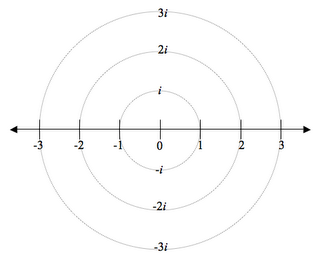
I went through the main ideas with them about what imaginary numbers are, how the imaginary number line works, and multiplying imaginary numbers. I used the "multiplying by i = 90 degree rotation" idea that I wrote about before, and with the use of Keynote animations, it was even more effective. I really suggest using this method to teach about powers of i.
Here are the files:
Lesson 1 (Intro to Complex Numbers)
Lesson 1 Keynote
Keynote Quicktime
Posted by
Dan Wekselgreene
0
comments
Labels: algebra 2, complex numbers, lesson
Thursday, December 07, 2006
Next Lesson: Powers of i; Basic Trinomial Factoring
Today in class, we started with a mini-lesson on finding the powers of i, using the "multiplying by i = rotating by 90 degrees about the origin" metaphor. I misjudged - I made it a self-paced worksheet, but it was too complex (no pun intended) for them to handle on their own. When I went over it with them as a class, they started to understand it a lot better, but it ended up taking much more time than I had planned. The circle help students see why the pattern repeats in 4s. If you start at 1 on the real axis, and make a full circle, you will have multiplied by i 4 times. Therefore, any multiple of 4 in the exponent will cause an integral number of circles, landing you back at 1. Then, the remainder indicates how many more rotations you need and where to end up on the complex plane.
I'm at the point in the year where finals are looming and I feel pressed to rush through the curriculum to finish the unit. But what's the point, if they're not going to retain information as I charge ahead? I may need to scale back my learning objectives for this unit, or for the upcoming units.
After the powers of i, I wanted to do a quick review of factoring out the greatest common monomial factor from a polynomial, as well as factoring quadratic trinomials where a = 1. This is basic stuff that they did in algebra 1, but they had forgotten so much of it. By the end of class, most of them were starting to remember having done this before... so I go back to my earlier question about retention. I feel like this is a fundamental algebra 1 concept that should be retained from spring of this year (when they learned it in algebra 1) until now. Maybe going through it again now will help them get it into longer term memory... but how many times do they need to review the same topic until it sinks in?
Instead of giving a worksheet for practice, I wanted to show students how I create factorable trinomials, and for them to create their own and quiz each other. I think that this will be an effective way to help give them a deeper understanding. Unfortunately, we ran out of time because of the earlier problems. I am moving this into tomorrow's lesson, so hopefully it will work out.
Posted by
Dan Wekselgreene
3
comments
Labels: algebra 2, complex numbers, factoring, lesson
Monday, December 04, 2006
Next Lesson: Operations on Complex Numbers
Tomorrow, the Do Now will introduce the idea of finding the distance to the origin on a coordinate plane by creating a right triangle and using the Pythagorean Theorem. Students must calculate the shortest distance from a given point back to the origin, where they left their sweeties, and therefore want to hurry back to.
Following this, I will do direct instruction on addition, subtraction, multiplication, and division. Multiplying by the complex conjugate for division will be a nice follow up to simplifying fractions like 2/(3 + root2) from the previous lessons. Then, we will recall what was learned during the Do Now to understand how to calculate the absolute value of a complex number. Students will plot complex numbers in the complex plane, and then draw a right triangle and calculate the length of the hypotenuse. I will ask students to figure out other complex numbers that have an equal absolute value, and to determine, given a set of complex numbers, which one is farthest from the origin.
Finally, students will have about 20 minutes to work on these types of problems in pairs and ask for help. Not a very exciting lesson, to be sure, but, for some reason, complex numbers and their operations seem to be hit pretty heavily on the STAR test, so it needs a lot of class time. I don't think students will be asked to find the absolute value of a complex number, but it is good scaffolding for the distance formula, which is an indispensable tool in any high school mathematician's bag of tricks.
The lesson will be posted on ILoveMath.
Posted by
Dan Wekselgreene
0
comments
Labels: algebra 2, complex numbers, lesson, standards
Friday, December 01, 2006
Next Lesson: Intro to Complex Numbers

Still catching up - this was today's lesson...
This lesson's scaffolding is based off of some ideas in the book Where Mathematics Comes From, by George Lakoff. I found this book to be fascinating, as it speaks directly to the question of whether math is a human discovery or a human invention. The book is firmly on the side of invention, explaining how a set of basic "grounding metaphors" create a foundation on which we've built the rest of mathematics. If you're interested in these ideas, I highly recommend reading it. Whether or not you agree with the conclusions, it'll really get you thinking.
In the book, they discuss the metaphor that is used to understand where the imaginary number i comes from. Essentially, you can think of multiplying by -1 on the real number line as a 180 degree rotation. Once you accept this metaphor, then it opens the question: multiplying by what number gives you a 90 degree rotation? If you multiply by that number twice, that means you've rotated 90 degrees twice. Since this is equal to 180 degrees, multiplying by the mystery number twice gives the same result as multiplying by -1. Therefore, the mystery number must be the square root of -1. Whoa. I thought that was an interesting way of looking at it. It allows you to then see why the imaginary axis is perpendicular to the real axis. It also allows you to see why the powers of i follow that 4 number pattern which students need to know. You can go around in a circle, stopping every 90 degrees at an axis. If you start from 1 on the real axis, you'll pass through 1, i, -1, -i, then back to 1. Also, this had an added benefit: one student asked what would happen if you rotate 180 degrees twice. He realized that this would be the same as multiplying by -1 twice. When I pointed out that this rotation would get you back to where you started from, I think his jaw dropped a bit - he may have finally understood a reason that explains why a "negative times a negative is a positive"!
So I designed a handout for students to work through these ideas, we discussed them, and I finished with about 20 minutes of lecture to tie it all together and do some exaxmples. I love this lesson, because I feel like it allows for some deep learning, and the mathematics are not that tough, so almost all students can follow it pretty easily.
This lesson will be posted on ILoveMath.
Posted by
Dan Wekselgreene
5
comments
Labels: algebra 2, complex numbers, lesson